
By Tom Elmore
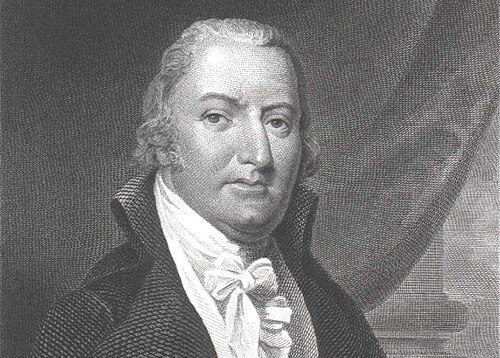
The Oxford Dictionary defines a “Renaissance man” as “a man with many talents or areas of knowledge” which perfectly describes Dr. David Ramsay. Ramsay, the son of an Irish immigrant, was born in 1749 in Dunmore, Pennsylvania. He graduated from the College of New Jersey (now Princeton University) in 1765. In 1773 he earned a medical degree from the University of Pennsylvania. Shortly afterwards, he moved to Charles Town, S.C. He became a very successful physician in his new home and is credited with introducing the smallpox vaccine to the Palmetto State.
Ramsay served in the South Carolina House from 1776 until 1783. He was a supporter of the American Revolution and served early in the war as an army surgeon. After the fall of Charleston on May 12, 1780, he was imprisoned by the British in St. Augustine, Florida for eleven months. After the war, Ramsay served in the U.S. Confederation Congress from 1785 until 1786, briefly serving as its president pro-tem. He later served in the South Carolina State Senate, serving as its president from 1792 until 1797. However his opposition to slavery and his friendship with northern abolitionists derailed his bids to return to Congress and as a U.S. Senator, effectively ended his political career.
His biggest legacy is his historical works starting with his two volume History of the Revolution in South Carolina published in 1785. (Said to be the first book published in America to be copyrighted.) He followed that up in 1789 with the two-volume History of the American Revolution, still one of the most respected books ever written about the war. In 1807 he wrote one of the earliest biographies of the First President, Life of Washington. In 1809 he published the two-volume History of South Carolina. His works on the American Revolution are especially noteworthy because his first hand experiences gave him a perception few others writers of the conflict had.
In his personal life, he was married three times. His first was in 1775 to Sabina Ellis, who was only 23 when she died in 1776. The second was Frances Witherspoon in 1783. Witherspoon was the daughter John Witherspoon, a signer of the Declaration of Independence. Frances died in 1784 at the age of 25. His third marriage in 1787 was to Martha Laurens, the well-educated daughter of Henry Laurens, President of the Second Continental Congress and signer of the Treaty of Paris which officially ended the American Revolution. His third marriage produced eleven children. Martha died in 1811 at the age of 52. Six weeks after Martha’s death, Ramsay published her diary and private letters as Memoirs of the Life of Martha Laurens which gives a glimpse of life in the South during the American Revolution from a woman’s point of view.
In his lifetime, Ramsay received numerous honors. In In 1789 he co-founded the Medical Society of South Carolina and served as its president in 1797. He also led efforts to found the Medical University of South Carolina. In 1803 Yale University awarded him an honorary doctor of medicine degree. Also in 1803 he was elected a member of Philadelphia’s American Philosophical Society, an organization co-founded by Benjamin Franklin in 1743 to promote research and study of the humanities and natural science. Since its founding only about 5700 invitations to join have been issued.
Ramsay was shot and killed in front of his Charleston home on 92 Broad Street on May 6, 1815 by William Linnen, a tailor who was known for filing excessive lawsuits and once threaten to kill his attorney. A judge had asked Ramsay to examine Linnen to which he reported that the man was “deranged” and it would be “dangerous to let him go at large.” Linnen was locked up, but after convincing the court that he was sane again, he was set free. On that fateful day, Linnen took out a pistol he had hidden in his handkerchief and shot the doctor twice in the back and the hip. Ramsay was carried inside where he died from his injuries two days later. Some say it was first assassination of an American politician. Ramsay was buried at the Circular Congregation Church cemetery. His three volume History of the United States was published posthumously.
It is a sad mystery why David Ramsay has faded into obscurity given that he was a pioneering medical practitioner, a hero of the American Revolution, a major political figure in the early days of the country and a noted scholar. Arguably, he was the Palmetto State’s answer to the more famous Thomas Jefferson and Benjamin Franklin. With the upcoming 250th anniversary of the American Revolution, hopefully more people will learn about this trailblazing Renaissance man.



 IrishAmerica250.org